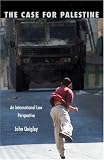
Product Description
John Quigley brings a necessary international law perspective to bear on the seemingly intractable Israeli-Palestinian conflict in this updated edition of his important book. Since 2000, the cycle of bloodshed and retribution has spiraled increasingly out of control. Quigley attributes the breakdown of negotiations in 2000 to Israels unwillingness to negotiate on the basis of principles of justice and law. He argues that throughout the last century, established tenets of international law--and particularly the right of self-determination--have been overlooked or ignored in favor of the Zionists and then the Israelis, to the detriment of the Palestinians.
In this volume, Quigley provides a thorough understanding of both sides of the conflict in the context of international law. He contends that the Palestinians have a stronger legal claim to Jerusalem than do the Israelis that Palestinian refugees should be repatriated to areas including those within the borders of Israel and that Israel should withdraw from the territory it occupied in 1967. As in his earlier volume, Quigley provides an extensively documented evaluation of the conflict over the last century, discussing the Zionist movement, the League of Nations decision to promote a Jewish homeland in Palestine, the 1948 war and creation of Israel, and Israels occupation of the West Bank, Gaza Strip, and Golan Heights during the 1967 war.
Rate Points :4.0
Binding :Paperback
Label :Duke University Press
Manufacturer :Duke University Press
ProductGroup :Book
Studio :Duke University Press
Publisher :Duke University Press
EAN :9780822335399
Price :$23.95USD
Lowest Price :$16.70USD
Customer Reviewsa strong case
Rating Point :5 Helpful Point :19
The title of the book and the case being made is that the Palestinian peoples in the territories Israel occupied in 1967 have a right to self-determination and a future beyond Israeli occupation and colonization through settlements.
The case begins with the conquest by the British of the region in the first world war. The British made promises to european jews that they could construct a homeland in the region. The problem then (as now) is that the land wasnt empty and constructing a new country on top of an existing people and civilization is an unjust act.
He then follows the sad situation through the 1920s and 1930s. As the colonial population grew, political conflict between Palestinians and Jews grew. The British were in a situation where there was no way out. The only way to create the Jewish homeland would be through mass deportation of Palestinians which would never have been considered legal.
The book then shifts to the 1948 war. Palestinians were driven as refugees from their homes by the war. After the war they were not allowed to return. The Israeli government systematically erased their villages with explosives afterward as if somehow to erase their existance from history.
The next major issue is almost 20 years later when as a result of the 1967 war Israel finds itself in military occupation of the west bank and gaza. And this is where the case against Israel grows large. Quigley shows how Israel has systemically ignored international law in the case of the occupation. The illegal annexation of eastern jerusalem and the region around. The colonization of the west bank and gaza. and so on.
He shows how the rise of the extreme right in Israel in the 1970s turned an occupation that might have been initially about security into de-facto annexation. The territories were run as if they were proviences of Israel called Judea and Samaria. The only difference being that the population of the territories was not annexed. They were left in a sort of rightless limbo. Their land could be taken from them and they could be told they could not even build houses while Israeli settlements went up around them. Quigley shows how law was turned on its head to accomplish all this.
The case made by the book will be clear to most. But a subset of fanatics will not understand it at all. They grew up with Israeli mythology, such as books by Joan Peters, telling them that Palestinians were imaginary. The arabs living in the west bank didnt belong there and only lived there are part of a plot to destroy Israel. The territories are not occupied, they are disputed. And as disputed territory Israel can do whatever it wants there including annexation of the land (but not the people).
Others will talk about the great harm done to the rights of Israelis if they are prevented from living in land under military occupation outside their own country. They talk of the 1930s and the injustice in denying them to live as citizens of Israel under Israeli law in a territory that is not part of Israel. Their right to do so is unimaginably important.
But on the other hand, Palestinians have to accept that it is the natural order of things that in those same territories they are entitled to no rights at all. That their greatest asperation in life should be a job in construction or cleaning. Doing the dirty jobs and manual labor that Israelis are too good to do themselves.
While they steal the land through their control of the law and the occupation, they claim that the palestinians are willing sellers. How can Palestinians in the territories who have no rights under Israeli law expect justice from the occupation or even the enforcement of laws or contracts? They know the answer to that. They cant.
Quigley doesnt deal with ancient history claims to the occupied territories. He deals with the reality that there is an palestinian population in the occupied territories today. Their claims are based on the fact that they exist as people living in those territories today. They are facts on the ground that no amount of Israeli propaganda can change.
Quigley has no time also for modern frauds like Joan Peters "from time immemorial" which "proved" that palestinians were imaginary and jews were always the majority in modern Israel and the occupied territories.
Quigley also dismisses those who deny the existance of Palestinians. He draws the correct conclusion in saying that a people who number in the millions now who live in a geographic region are a national group. And that their most basic right is the right to live where they are, not be called "arabs" and dumped in Lebannon or Jordan or somewhere else.
But for his critics, occupation isnt occupation. Settlements are really Israeli towns, Palestinians dont exist and Israel has effectively annexed the entire land of the west bank into itself but somehow not annexed a single person living there. Quigley shows what the law says and that from the law rather than from religious belief or moral history or guilt or events that happened in europe, that the Palestinians have the stronger case.
Rating Point :5 Helpful Point :11
This excellent survey is a new edition of John Quigleys 1990 classic, Palestine and Israel. The author, who is Professor of Law at Ohio State University, examines the origins of the Zionist-Arab conflict in Palestine, the League of Nations decision to promote a Jewish homeland in Palestine, the 1948 war and the establishment of Israel, the status of Arabs in Israel, the 1967 war, Israels illegal occupation of the West Bank and the Gaza Strip, and the way to resolve the Palestine-Israel conflict.
During and after the 1948 war, Israeli forces drove 780,000 Palestinian Arabs out of the most densely populated areas of Palestine: only 60,000 remained. As the commander of the Palmach, the elite unit of the Israeli army, admitted, "We did everything to encourage them to flee."
From 1950 onwards, when Palestinians attempted to cross into Israel to attend to their land, Israel repeatedly attacked its Arab neighbours. The UN Security Council condemned these attacks saying, "reprisals have proved to be productive of greater violence rather than a deterrent to violence." This remains true right up to todays brutal Israeli assaults on Gaza and Lebanon.
Mordecai Bentov, who was a cabinet minister when Israel attacked the Arab states in 1967, wrote that Israels entire story about the danger of extermination was "invented of whole cloth and exaggerated after the fact to justify the annexation of new Arab territories."
Quigley attributes the breakdown of negotiations in 2000 to Israels refusal to negotiate on the basis of principles of justice and law. He contends that the Palestinians have a stronger legal claim to Jerusalem than do the Israelis that Palestinian refugees should be repatriated to areas including those within the borders of Israel and that Israel should withdraw from all the territories it occupied in 1967.
He argues that throughout the twentieth century and into the twenty-first, Israel and its allies have overridden the basic tenets of international law, particularly the right of self-determination, to the detriment of the Palestinians. He concludes that the conflict can only be ended by establishing a viable Palestinian state.
Does not make a reasoned case
Rating Point :1 Helpful Point :10
I was puzzled by the title of this book. What case was it supposed to make? Maybe the case that there was an ancient Levantine Arab People who were unjustly treated and who now deserve Justice? Or the case that Jews are special, and must be denied the right to buy land and live on it, even in their homeland?
Well, the book begins by explaining why Jews, who were being seriously mistreated in Europe (and elsewhere) wanted to move to the Levant. But it basically says that it was fundamentally unjust for Jews to purchase land there, since that displaced the farmers who lived on it.
Now, maybe the author knows something about law. But I think what he says is so unhelpful that it does not matter how much he knows about law, or how little I know about it. Such a claim by him is either founded in law (and he says it is) or it isnt. And it really doesnt matter. If that claim is not founded in law, we ought to toss his book away. If it is founded in law, then the law has to say one of two things. Either it is illegal for any human to be born, since all of us displace folks just by existing. Or it is illegal for certain untermenschen to have any rights, which is a racist set of laws that I reject. Im sure the German National Socialists were proud of their laws. But at some point, we have to reject bad laws. And if people who need and want land, which is for sale by willing sellers, are not allowed to purchase it, even though they are high bidders, and even though lower bidders are allowed to buy it, we need to reject such laws.
There are plenty of things wrong with Quigleys arguments. But the most fundamental is that the answers are wrong.
Quigley dismisses ancient claims to the Levant. Thats fine with me. But hes selective about it. Jewish claims, Pagan claims, and Byzantine claims are considered bogus. Arab claims, on the other hand, are legitimate! Thats a little silly, especially given that Arabs only lightly populated the region, were not sovereign there for centuries, and were the majority only because they didnt let Jews enter in significant numbers.
Quigley discusses the question of Levantine Arab "distinctiveness." Thats a good question! After all, it is more than a technicality to say, ex post facto, that your fist always had a right to be where someone elses nose turned up! Inventing a particular Arab people and claiming that they had a right to all Jewish land and no other land seems like the same deal. Their fists have rights, Jewish noses do not. But Quigley claims that Levantine Arab distinctiveness is irrelevant because Arabs lived there! Um, thats ridiculous. Mongols lived in Russia, and outnumbered the Russians once the Mongols had killed most of the Russians. But the Mongols populated the region only lightly. It was a Mongol colony, not the Mongol homeland. And the Russians reclaimed it. It is quite relevant that the Levant was an underpopulated backwater of an Arab Empire which housed Jerusalem, the Jewish capital. It explains why Jews outbid Arabs for one parcel of land after another once they had a chance to do so.
And, oh yes, Arab aggression against Israel in 1948 and 1967 is somehow called Israeli aggression. And Israeli towns in the West Bank are called illegal.
One cant do everything in a book. One cant toss absurd and false taunts at a party to a dispute and still present a well-reasoned case. Quigely had a choice to make. He could state his complaints honestly and sincerely, and try to make a case. Or he could taunt Zionists. He chose to do the latter. That precluded him from making a case in favor of anyone. Maybe he had a bad case in the first place, but I still think he ought to have done better than this.
A stunning history in a legal context that will blow readers away
Rating Point :5 Helpful Point :12
John Quigley, professor of Law at Ohio State University and a leading American expert in humanitarian law, has written a 2005 update of his 1990 The Case for Palestine. Quigley introduces this book with the hope that it will be used to further peace between Israel and Palestine through better understanding of the situation. The book is highly readable, despite numerous but unobtrusive academic footnotes the story Quigley relates will stun many who thought they understood much of this historical background.
Quigley starts at the beginning of the Zionist movement, when the first Zionists considered (and tried to obtain at least one of) various locations for a Jewish homeland. This initiative met with success not from a groundswell of support from any Jewish community, but from the persuasion of British officials that a client state near the Suez Canal and oil fields would be useful to British interests. The British requested the British Mandate in 1922 which allowed the Zionist state to develop safely.
Quigley shows that the real start of Israel was not from the UN but was from US President Harry Truman. The UN General Assembly Resolution 181, which laid out a partition of Palestine in 1947 was merely a recommendation that did not even pass! The US had decided that the proposed partition was unworkable and its own UN delegates were about to help draw up a trusteeship for Palestine when President Truman stunned everyone by recognizing Israel after Israel declared itself a state in May of 1948. According to Quigley, Israel had neither title nor legal claim to any part of Palestine until Arafats recognition at the 1993 Oslo Accords.
Quigley notes that the rationale for Israels existence as a Jewish refuge was enhanced by Zionist and Israeli actions. Jewish immigration after WW II was often as a result of either the lobbying of foreign governments to curtail the opportunities for refugees to move to countries other than Israel or Israeli intelligence operations that created the belief that Jews were under attack in various countries.
Quigley not only notes that Israel was the aggressor in the 1967 Six Day War which started the occupation of Palestinian and Syrian territory, but also discounts the Israeli rationale for its aggression, putting this instead in the context of Israels various attempts to expand its territory.
Quigley describes the current grim situation of Palestinian civilians under occupation noting the legal legitimacy of their armed resistance to occupation forces, a resistance that is too often described as "terrorism" in our media. He notes that world judicial bodies give more legitimacy to those seeking their self-determination than to colonizers trying to maintain their power.
This fascinating book is filled with history in a legal context that will equip readers to speak knowledgeably about this situation. It is an important contribution to public understanding as well as media balance, which too often repeats a one-sided perspective of both history and ongoing events.
 In this timely new edition of Peace Process, William B. Quandt analyzes how each U.S. president since Lyndon Johnson has dealt with the complex challenge of brokering peace in the Middle East, from the 1967 Arab-Israeli war to the death of Yasir Araf
 Joel Kovel argues that the inner contradictions of Zionism have led Israel to a "state-sponsored racism" fully as incorrigible as that of apartheid South Africa and deserving of the same resolution. He argues that only a path toward single-state secu
 In this controversial new book, a prominent Israeli historian at Haifa University revisits the formative period of the State of Israel. Decisively debunking the myth that the Palestinian population left of their own accord during the War of Independe
 The Case for Israel is an ardent defense of Israels rights, supported by indisputable evidence. Presents a passionate look at what Israels accusers and detractors are saying about this war-torn country. Dershowitz accuses those who a
 This book provides a comprehensive survey of the international legal principles related to the Palestinian struggle for self-determination starting with the League of Nations awarding the Mandate for Palestine to Britain after the First World War
0 ความคิดเห็น:
แสดงความคิดเห็น